Oz to ML Perfume Complete Bottle Size Conversion Chart
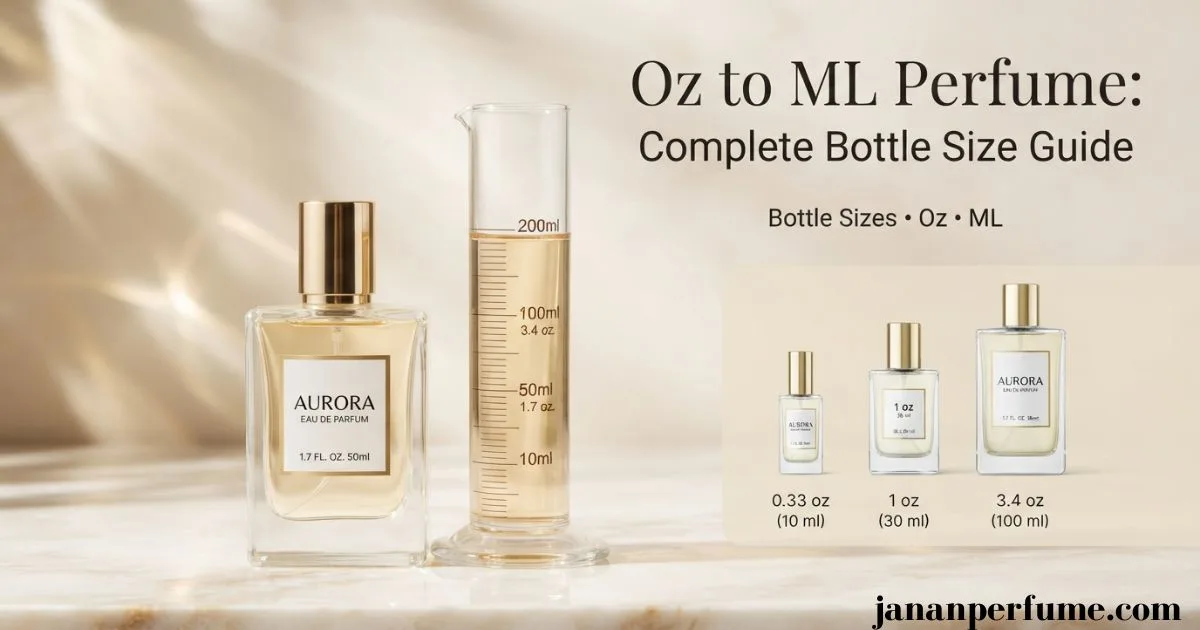
If you are wondering how many milliliters are in an ounce of perfume, the quick answer is 1 US fluid ounce = 29.5735 ml, although perfume bottles commonly round that to 30 ml. The same pattern explains why 1.7 oz is usually 50 ml and 3.4 oz is usually 100 ml. Understanding perfume sizes, fluid ounces, milliliters, bottle volume, and fragrance packaging makes shopping much less confusing.
I have seen this confusion repeatedly when comparing fragrance bottles online: the calculator says 100.55 ml, while the box says 100 ml. That does not automatically mean anything is wrong. Commercial perfume sizes use rounded ounce declarations, while the metric fill is normally the clearer specification. This guide explains the conversion, common bottle sizes, value, travel considerations, and the buying decisions behind them.
Quick Answer: Oz to ML Perfume Conversion
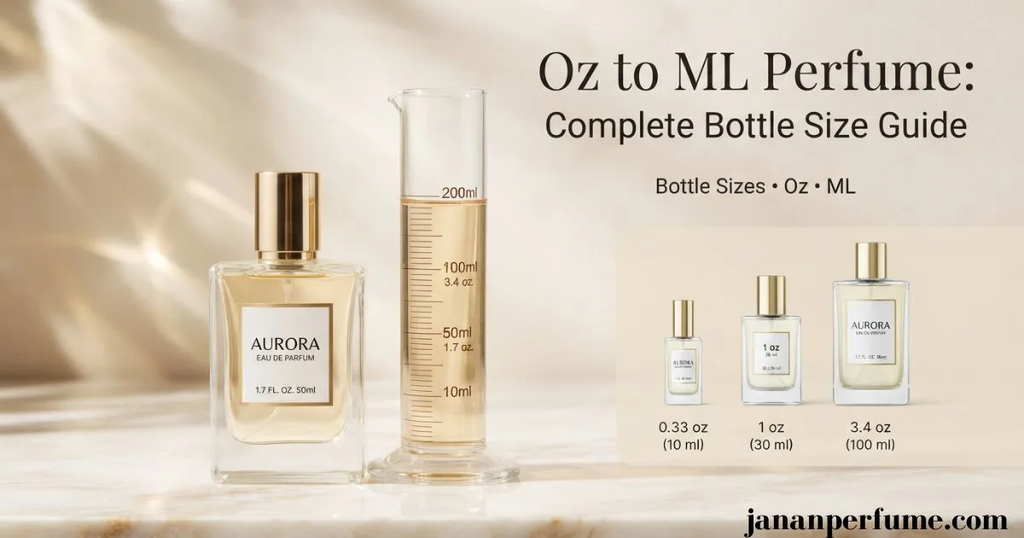
For oz to ml perfume calculations using the US fluid ounce, multiply the ounce number by 29.5735. That gives the mathematical conversion. In everyday fragrance shopping, however, brands commonly pair 1 oz with 30 ml, 1.7 oz with 50 ml, and 3.4 oz with 100 ml because those are clean commercial sizes.
| Perfume Size | Exact US Conversion | Common Label |
| 0.17 oz | 5.03 ml | 5 ml |
| 0.25 oz | 7.39 ml | 7.5 ml |
| 0.5 oz | 14.79 ml | 15 ml |
| 1 oz | 29.57 ml | 30 ml |
| 1.7 oz | 50.27 ml | 50 ml |
| 2 oz | 59.15 ml | 60 ml |
| 2.5 oz | 73.93 ml | 75 ml |
| 3 oz | 88.72 ml | 90 ml |
| 3.4 oz | 100.55 ml | 100 ml |
| 4 oz | 118.29 ml | 120 ml |
| 6.7 oz | 198.14 ml | 200 ml |
These figures explain most perfume-label questions shoppers encounter. The exact conversion and the commercially labeled size are not always identical to the last decimal place. When comparing bottles, use the manufacturer’s stated metric size rather than assuming the arithmetic result is the actual nominal fill.
How the Oz to ML perfume Conversion Works
The formula for oz to ml perfume is straightforward: milliliters = US fluid ounces × 29.5735. For example, 1.7 × 29.5735 equals approximately 50.27 ml. Conversely, to convert milliliters into US fluid ounces, divide the milliliter figure by 29.5735.
The confusing part begins when shoppers compare the mathematical result with the number printed on a perfume box. A 3.4 oz calculation produces about 100.55 ml, yet many bottles are labeled 100 ml. That difference reflects rounding and commercial labeling, not necessarily a difference in the fragrance itself.
US Ounces vs. UK Ounces
For US perfume shopping, the relevant measurement is normally the US fluid ounce, equal to approximately 29.5735 ml. The UK Imperial fluid ounce is different at about 28.4131 ml. Therefore, an “ounce” without identifying the measurement system can create a misleading comparison between American and British volume figures.
This distinction matters most when comparing international product listings. If a retailer gives both units, the milliliter figure is usually the easiest common reference. A 50 ml bottle remains 50 ml regardless of whether another market describes its approximate volume using US or Imperial fluid ounces.
Perfume Ounces to Milliliters Chart
The most useful oz to ml perfume chart centers on the sizes shoppers repeatedly encounter: 5 ml samples, 15 ml travel bottles, 30 ml small bottles, 50 ml standard bottles, and 100 ml large bottles. Larger 150 ml and 200 ml formats also appear, particularly in cologne and value-oriented fragrance ranges.
| Ounces | Approx. Exact ML | Typical Perfume Format |
| 0.17 oz | 5.03 ml | Sample |
| 0.5 oz | 14.79 ml | Travel size |
| 1 oz | 29.57 ml | Small full-size |
| 1.7 oz | 50.27 ml | Standard full-size |
| 2.5 oz | 73.93 ml | Mid-size |
| 3.4 oz | 100.55 ml | Large full-size |
| 4 oz | 118.29 ml | Extra-large |
| 5 oz | 147.87 ml | Large format |
| 6.7 oz | 198.14 ml | Jumbo/value |
The chart is especially helpful when shopping across retailers because one website may display 50 ml, another 1.7 oz, and a third both. Those listings can describe the same nominal bottle. The key is to compare the actual metric capacity and product concentration before deciding that two listings are different.
Perfume Bottle Sizes in ML and OZ Explained
A 30 ml perfume is approximately 1 oz and is often attractive when you are testing a new fragrance. A 50 ml perfume is approximately 1.7 oz and provides a middle ground between commitment and value. A 100 ml perfume is approximately 3.4 oz and is common for established favorites.
| Bottle Size | Approx. Ounces | Best Use |
| 5 ml | 0.17 oz | Sampling |
| 15 ml | 0.5 oz | Travel |
| 30 ml | 1 oz | First full bottle |
| 50 ml | 1.7 oz | Regular wear |
| 75 ml | 2.5 oz | Mid-size option |
| 100 ml | 3.3–3.4 oz | Signature scent |
| 125 ml | 4.2 oz | Large format |
| 150 ml | 5–5.1 oz | High-volume use |
| 200 ml | 6.7–6.8 oz | Jumbo/value |
Bottle size does not tell you fragrance strength. A 50 ml Eau de Parfum and a 50 ml Eau de Toilette contain the same volume but may have different fragrance concentrations and therefore different usage patterns. Volume answers how much liquid you have, not how strong the fragrance is.
50 ml vs. 100 ml Perfume: Which Size Should You Buy?
A 50 ml perfume usually makes sense when you are still exploring a fragrance, rotate several scents, or want a manageable bottle. A 100 ml perfume can provide a lower cost per milliliter when discounted pricing does not reverse the normal relationship. But a bigger bottle only creates value if you actually use it.
| Factor | 50 ml / 1.7 oz | 100 ml / 3.4 oz |
| Upfront cost | Usually lower | Usually higher |
| Cost per ml | Often higher | Often lower |
| Travel | Easier | Bulkier |
| Variety | Better for rotation | Less variety |
| Commitment | Lower | Higher |
| Best for | Exploring/regular use | Confirmed favorite |
There is an emotional side to this choice, too. Buying a large bottle of a fragrance you have never worn can feel like a bargain until the scent sits untouched. If you already finished a bottle and know you reach for it constantly, moving to 100 ml becomes much easier to justify.
Bottle Size Buying Guide
The best oz to ml perfume size depends on how you actually wear fragrance. For a first purchase, 30 or 50 ml reduces financial risk. For a confirmed signature scent, 100 ml may provide better value. For collectors, multiple smaller bottles can create more variety without leaving one fragrance open for years.
A practical rule is simple: test first, commit second, stock up third. A 5 ml sample can tell you more about skin chemistry and real-world enjoyment than a large bottle ever will. Once a fragrance survives a full-day wear test and repeated use, choosing between 50 ml and 100 ml becomes primarily a value and lifestyle decision.
Why are perfume bottles sold at 30, 50 and 100 ml?
The popularity of 30 ml, 50 ml, and 100 ml is largely a matter of industry convention, packaging, tooling, retail presentation, and consumer expectations. Brands are not generally required to use only these three sizes. Fragrance companies also offer 15, 75, 125, 150, 200 ml, and other formats.
These sizes also correspond neatly with different buying stages. Thirty milliliters can represent an entry commitment, 50 ml works as a balanced everyday bottle, and 100 ml suits someone who already knows a fragrance belongs in their rotation. The bottle size therefore becomes part of the commercial strategy as well as a measurement.
Why does the bottle say 1.7 oz and 3.4 oz?
A bottle may show 1.7 oz / 50 ml or 3.4 oz / 100 ml because brands commonly print both customary and metric measurements for consumer labeling. The mathematical conversions are approximately 50.27 ml and 100.55 ml, but the commercial metric sizes are 50 ml and 100 ml.
That is why seeing a calculator result of 100.55 ml should not make you think a 100 ml bottle is underfilled. The product’s nominal metric capacity and its rounded fluid-ounce declaration are different representations of the same commercial size. Always check the manufacturer’s stated ml quantity when comparing products.
Why is price per millilitre the only honest comparison?
Price per milliliter gives shoppers a cleaner way to compare 30 ml, 50 ml, and 100 ml perfume bottles. Divide the bottle price by its milliliter volume. A larger bottle often has a lower cost per ml, but discounts can reverse that pattern, so calculate the actual prices you see rather than assuming bigger is cheaper.
For example, if a 50 ml bottle costs $80, its price is $1.60 per ml. If a 100 ml bottle costs $150, its price is $1.50 per ml. The larger bottle is cheaper per ml, but only by ten cents. If you would never finish the extra 50 ml, the apparent bargain may not be useful.
Why Your Oz to ML Perfume Math Doesn’t Match the Box
The most common oz to ml perfume confusion happens with 3.4 oz. Multiplying 3.4 by 29.5735 produces approximately 100.55 ml, yet perfume packaging commonly identifies the bottle as 100 ml. The reason is simple: the ounce declaration is rounded rather than a claim that the metric fill equals the raw multiplication result.
The same thing happens with 1 oz and 1.7 oz. One US fluid ounce equals about 29.57 ml, but commercial perfume packaging commonly uses 30 ml. Likewise, 1.7 oz is about 50.27 ml, while the standard bottle is labeled 50 ml. The pattern is normal rather than suspicious.
Matching Bottle Size to How You Actually Wear Fragrance
Your fragrance habits should determine the bottle size more than the apparent bargain. If you are still testing a scent, a 5 ml sample or decant minimizes risk. If you like it but rotate fragrances, 30 or 50 ml can make sense. If it is your daily signature, 100 ml may provide stronger value per ml.
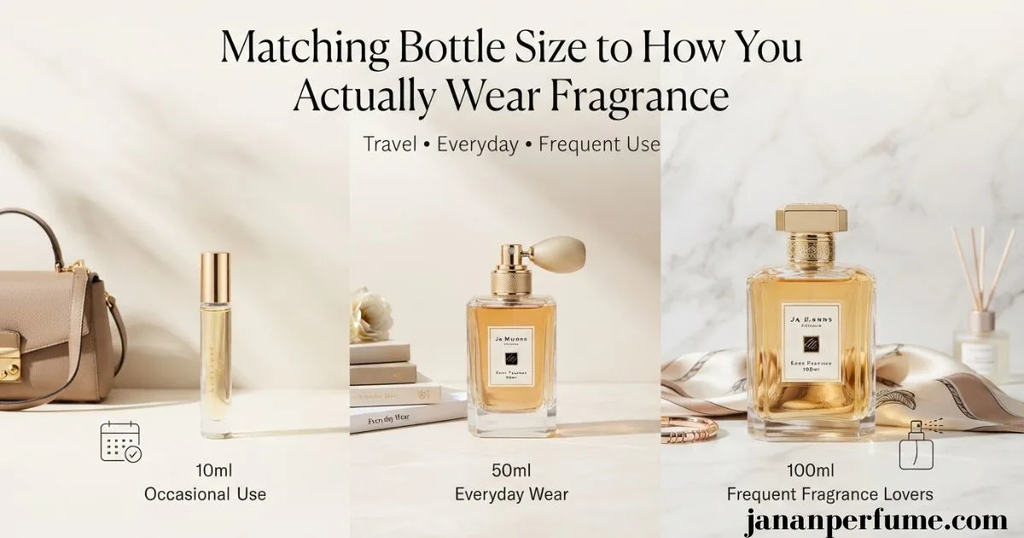
Travel is another reason to think beyond price. Smaller bottles are easier to carry, while a 100 ml container sits at the common US carry-on liquid threshold. TSA’s current rule should always be checked before flying because security procedures and exceptions can change; do not assume a bottle is permitted simply because it contains less liquid than its labeled capacity.
Conclusion
The simplest oz to ml perfume rule to remember is 1 US fluid ounce = 29.5735 ml, while perfume packaging commonly rounds that to convenient sizes such as 30 ml, 50 ml, and 100 ml. That is why 1 oz usually corresponds to 30 ml, 1.7 oz to 50 ml, and 3.4 oz to 100 ml.
For shopping, do not let the decimal difference confuse you. Compare the manufacturer’s stated milliliter size, concentration, actual price per ml, and how quickly you expect to use the fragrance. A 50 ml bottle can be smarter than 100 ml if you rotate scents, while 100 ml can make sense for a confirmed signature fragrance.
The biggest lesson is that volume and value are not the same thing. Knowing the oz to ml perfume conversion helps you understand the bottle, but your wearing habits determine which size is genuinely worth buying.
FAQ Section
How many ml is 1 oz of perfume?
1 US fluid ounce equals 29.5735 ml, but perfume bottles commonly round 1 oz to 30 ml for commercial labeling. Therefore, a perfume marked 1 oz / 30 ml is generally the same nominal size expressed in two measurement systems.
How many ml is 1.7 oz of perfume?
1.7 US fluid ounces equals approximately 50.27 ml mathematically. Perfume manufacturers commonly label that size as 50 ml, so 1.7 oz and 50 ml generally refer to the same commercial bottle size.
How many ml is 3.4 oz of perfume?
3.4 US fluid ounces equals approximately 100.55 ml mathematically, while perfume packaging commonly labels the bottle 100 ml. The difference comes from rounding the fluid-ounce declaration.
Is 3.3 oz the same as 3.4 oz perfume?
Often, yes, when both labels refer to a 100 ml bottle. One source notes that 100 ml converts to about 3.3814 US fluid ounces, allowing the ounce declaration to appear as 3.3 or 3.4 depending on rounding. Check the metric quantity on the package.
How many sprays are in a 50 ml perfume bottle?
There is no universal spray count because atomizer output varies by bottle and pump design. A theoretical estimate can be made by dividing usable liquid volume by the measured amount released per spray, but actual sprays will differ between fragrances and atomizers.
Is 100 ml perfume better than 50 ml?
Not automatically. 100 ml often has a lower cost per ml, but 50 ml may be more practical if you rotate fragrances, travel frequently, or are unsure how often you will wear the scent. The best size depends on usage rather than volume alone.
What size perfume can I take on a plane?
For US carry-on travel, TSA generally limits individual liquid containers to 3.4 oz (100 ml) or less, subject to the current TSA rules and screening procedures. A bottle’s capacity matters even if there is less liquid remaining inside it.
Does perfume concentration change the oz-to-ml conversion?
No. Volume conversion remains the same whether the fragrance is Parfum, Eau de Parfum, Eau de Toilette, or Eau de Cologne. Concentration can affect how much fragrance is used per application and therefore how long a bottle lasts, but it does not change the volume conversion itself.
Why do perfume bottles use both oz and ml?
Perfume manufacturers commonly provide both measurements so consumers in different markets can understand the product volume. In the US, consumer packaging rules require net quantity declarations using customary and metric systems under the relevant labeling framework.
Is 50 ml the same as 1.7 oz?
Yes, as a commercial perfume size. Fifty milliliters equals about 1.6907 US fluid ounces, which is normally rounded to 1.7 oz on fragrance packaging.
Is 100 ml the same as 3.4 oz?
Yes, as a common commercial perfume size. One hundred milliliters equals about 3.3814 US fluid ounces, which is commonly displayed as 3.4 oz.
How do I calculate oz to ml perfume myself?
Use:
mL = US fl oz × 29.5735
For example:
2 oz × 29.5735 = 59.15 ml
For the reverse conversion:
US fl oz = mL ÷ 29.5735
This formula works for perfume, cologne, Eau de Parfum, and Eau de Toilette because the measurement conversion depends on volume, not fragrance category.